Out now
You know you need a strategy. But what do you do on Monday?
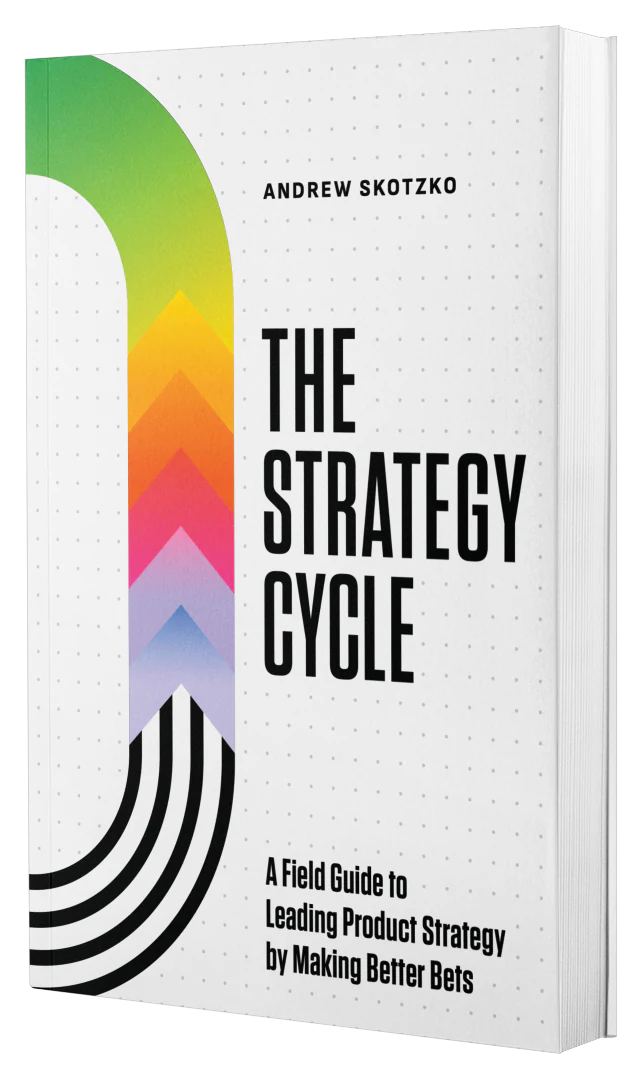
For product leaders and founders. Turn a blank page into a strategy your team can act on, then keep it alive as reality changes.
Make a real strategy. Then make it real.
See a strategy built start to finish, then build yours with 7 templates.
I’ll also send you my essays, new tools I make, and the best ideas I find.
Praise for the book
Andrew is a proven product leader and product leadership coach who has set out to help product leaders with one of the most important yet most difficult responsibilities of product leadership: creating a winning product strategy. If you’re a product leader operating in the product model, this book can help you succeed.
 Marty Cagan
Founder, Silicon Valley Product Group
Marty Cagan
Founder, Silicon Valley Product Group
Most strategy books tell you what strategy is. Andrew has written a field guide that tells you what to do on Monday morning, and more unusually, what to do in week 7 when the strategy is quietly falling apart.
 Martin Eriksson
Founder of Mind the Product, author of The Decision Stack
Martin Eriksson
Founder of Mind the Product, author of The Decision Stack
‘Be more strategic’ is the product equivalent of being told to ‘just relax’: clear on the outcome, completely useless on how to get there. This is the first book that actually gives you the how: a repeatable practice you can put to work on Monday.
 Rajiv Chopra
SVP AI & Product, Digible
Rajiv Chopra
SVP AI & Product, Digible
I’ve used Andrew’s strategy material in countless coaching sessions already - I had a front-row seat while he was writing this book, so I know how tried and tested it is. A must-read.
 Petra Wille
Product Leadership Coach, author of Strong Product People
Petra Wille
Product Leadership Coach, author of Strong Product People
The most to-the-point and actionable product strategy resource I’ve come across. I’ve been running this method for two years while scaling our business, and it works.
 Tristan Doherty
CPO, LG Energy Solution Vertech
Tristan Doherty
CPO, LG Energy Solution Vertech
The Strategy Cycle does something rare in product strategy: it turns an intimidating leadership responsibility into a practical operating rhythm.
 Christian Idiodi
Partner, Silicon Valley Product Group
Christian Idiodi
Partner, Silicon Valley Product Group
In a world where AI dramatically expands what’s possible, the leaders who win won’t be the ones with the most ideas, they’ll be the ones who make the best bets. Andrew has written a practical, clear, and highly actionable guide that helps leaders navigate uncertainty with confidence.
 Barry O’Reilly
Cofounder of Nobody Studios, author of Artificial Organizations
Barry O’Reilly
Cofounder of Nobody Studios, author of Artificial Organizations
I’ve sat through too many board meetings where the ‘strategy’ was a forecast essentially built on hope. I’d want to put this book in the hands of every executive in our portfolio.
 Daniel Eckert
Lead Operating Partner, Corsair Capital
Daniel Eckert
Lead Operating Partner, Corsair Capital
A lot of product leaders are intimidated by strategy. Most strategy books tell you why strategy matters. Very few show you where to start. Andrew closes that gap.
 Chris Jones
Partner, Silicon Valley Product Group
Chris Jones
Partner, Silicon Valley Product Group
Strategy books line my bookshelves, but this is the one I reach for time and time again. I put it through its paces across multiple product strategy sprints and board meetings.
 Cassie Campbell
SVP Product & Tech, Plug
Cassie Campbell
SVP Product & Tech, Plug
This is the strategy guide I wish someone had handed me on day one of being a CEO.
 Dan Clark
CEO, Brain.fm
Dan Clark
CEO, Brain.fm
The problem
Most "strategies" aren't.
They're plans, roadmaps, goals, budgets, and wishlists standing in for the real thing.
The promise
The Strategy Cycle is a hands-on field guide to actually doing strategy: using what you control to impact what you don't.
Read it on a flight, use it when you land. About a 3-hour read.
Inside the book
Craft the strategy.
Live the strategy.
Repeat.
-
Living in bets
Why most "strategies" aren't, and what to do instead.
Strategy is an evolving theory of winning, expressed through a cycle of bets. If planning is painful, it's often a sign of a weak or missing strategy.
-
Part OneCraft the strategyMake the actual choices a real strategy is made of and bring people along for the ride, building alignment every step of the way.
-
Start with a strategy sketch
A working draft of your strategy on paper by the end of chapter two.
The two-page sketch you can come back to and sharpen with each cycle. Start rough, get something real on the page, then make it strong.
-
Distill the context
What's going on?
Understand where things are, where they're going, and why. Use this to distill the beliefs at the foundation of your strategy.
-
Frame the challenge
What must we solve?
Identify the real challenges, narrow to the one that matters, and write a crisp challenge statement. If you can't name it in a sentence, you have a wishlist, not a strategy.
-
Define the value thesis
Why will customers choose us, and keep choosing us?
Get specific about who you're for, what they're really hiring you to do, and how you'll build durable, differentiated value. This is the core of your strategy.
-
Develop the approach
How will we make this real?
Translate the value thesis into the strategic themes you'll go after. Develop the big moves, the logic that connects them, and stress-test the approach before you commit to it.
-
Decide the bets
What will we do, not do, and why?
Draft a portfolio of bets to put the strategy into action, draw the line on what's in and out, and document the rationale so it can travel well.
-
But what about…?
Real answers for the questions every strategy hits on contact with reality.
Edge cases and practical FAQs like:
- What about AI?
- What's the fastest version of this?
- What if there's no business strategy?
- What if we have no differentiation?
- Why is strategy so damn hard?
…and more real-world issues.
-
Part TwoLive the strategyCrafting a strong strategy is maybe 40% of the work. The other 60% is deploying it, managing it, and evolving it.
-
Deploy the strategy
Place your bets.
Communicate, operationalize, and verify understanding to create the conditions for highly aligned, autonomous decision making. This is where planning lives.
-
Manage the strategy
Live your bets.
The ongoing, active work to keep the strategy alive and stay on course after week two of the quarter, when the shiny new things start arriving.
-
Evolve the strategy
Choose again.
Run the cycle again. The first cycle is the heaviest lift: after that, most quarters are a refresh, not a restart. Use what you've learned to sharpen the bets and make the strategy stronger.
-
Becoming a strategist
Be someone who leads strategy. Not someone who wrote a strategy once.
The best strategists aren't the ones who know the most frameworks. They're the ones with the judgment to know what matters, the conviction to make hard choices, and the humility to change course when reality says they should.
-
Segmentation, JTBD, Differentiation, Defensibility
Deeper dives on the four components at the heart of your strategy.
Pull these in when you need them. Reference material for the moments where the main path needs more horsepower under the hood.